
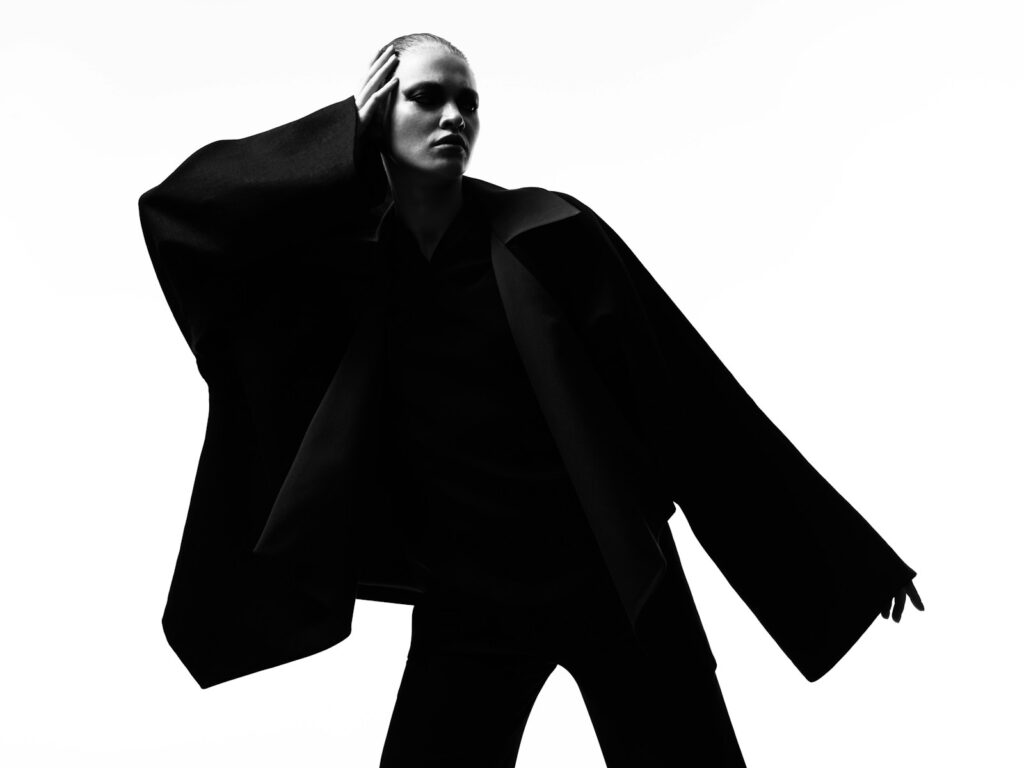
Spring 2024 was the season fashion finally had to absorb several leadership changes at once. Sabato De Sarno was now a full season into Gucci. Daniel Lee was on his second collection for Burberry. Pharrell had taken Louis Vuitton menswear in a direction nobody quite expected. And after eight years of speculation, Phoebe Philo’s namesake brand had actually shipped product. The runways themselves were quieter than they’d been in years — fewer logos, more cashmere, more navy and cream and brown. Critics called it the apex of “quiet luxury.” We mostly noticed the casts of clothes the houses wanted us to buy were now narrower, more specific, and considerably more expensive. There were still moments of drama — Schiaparelli, Daniel Roseberry’s coronation roses — but the cumulative effect was a season that asked you to choose your house and then pay attention to its language.
Sabato De Sarno’s Gucci grew into itself
Sabato De Sarno’s first Gucci ready-to-wear had landed in September 2023 to mixed reviews — a hard pivot away from Alessandro Michele’s maximalism into pared-back sensuality. By Spring 2024 the language was clearer. Slip dresses in a specific shade of burgundy the house had begun calling “Ancora Red,” sharp-shouldered tailoring, the GG canvas appearing only on a single bag in a collection of eighty looks. The takeaway: Gucci under De Sarno is a brand for women who already know what they want and want to be seen wearing it well, rather than a brand that asks you to play dress-up. We’re not certain that’s the commercially-better Gucci — the Michele years moved an enormous volume — but it’s a Gucci with a clearer point of view than it had at the end of the previous era.
Daniel Lee’s Burberry doubled down on Britishness
Daniel Lee’s second Fall collection at Burberry showed at London Fashion Week in February and immediately settled the question of what his Burberry would be: rugby shirts, equestrian boots, gabardine in earth-pony shades, the trench reframed as something between a duster and a hunting coat. The Knight Bag, which Lee had introduced in his first season, was now a real handbag franchise. The takeaway is harder to assess at retail — the heritage codes resonate but the price points are firmly luxury, and Burberry’s strategy of moving upmarket has been a slow-burn the wider market is still digesting. As a creative proposition, though, this was the most confident Burberry has felt since Christopher Bailey’s middle years.
Phoebe Philo’s brand finally arrived
Phoebe Philo had not shown a collection of her own since she left Céline in 2017. Her namesake brand — funded in part by LVMH with full creative control — finally dropped its first edit at the end of October 2023 via a controlled e-commerce drop, and the conversation extended through spring as pieces arrived in customers’ hands. The clothes were exactly what readers of her old Céline work would have predicted: slouchy coats, weighty leather, conceptual but wearable trousers, jewelry that read as art objects. The pricing was steep enough that the average reader of this blog won’t shop the line directly. But the influence on the rest of the market — the persistence of “quiet luxury” at The Row and the rapid expansion of that aesthetic at the high street level — owes a lot to Philo just by virtue of her returning. The takeaway: when a generational designer comes back, the entire conversation recalibrates around her.
Schiaparelli kept couture in the headlines
Daniel Roseberry’s couture Spring 2024 show at Schiaparelli in late January extended his streak of viral runway moments — flower-encrusted bodices, sculptural gold breastplates, Bella Hadid as the season’s most-photographed muse. The interesting move at Schiaparelli now is the way the couture work feeds the ready-to-wear and accessories business: the house has resisted ballooning into a full lifestyle brand, but every season’s couture statement gets distilled into a wearable lipstick-and-earrings tier that customers can actually afford. The takeaway: Schiaparelli is the rare house where the couture is a real business engine for the brand, not a money-losing PR exercise.
The quiet-luxury vocabulary kept widening
“Quiet luxury” had been the discourse-defining phrase of 2023 — Succession’s Logan Roy fleeces, Loro Piana cashmere everywhere, no logos as the new status. By Spring 2024 it had matured into something more pragmatic: a generation of younger shoppers re-orienting toward fewer, better pieces from houses that had always made fewer, better pieces. Bottega Veneta under Matthieu Blazy continued building a quiet-loud version of this — distinctive enough to register as Bottega without ever requiring a logo. Loewe under Jonathan Anderson kept the conceptual streak alive. Alaïa under Pieter Mulier was the unexpected dark horse — the brand had quietly become the destination for evening looks among editors and stylists. The collective effect: a top tier of luxury that didn’t need to shout, and a customer base finally rewarding it.
What we are watching for the rest of spring
Met Gala on May 6 — the “Garden of Time” theme around the Sleeping Beauties exhibition opens up an exceptional range of interpretation, and we’ll be looking at which designers commit hardest. We’re watching whether Phoebe Philo’s second drop expands the brand’s footprint beyond the initial e-commerce pop. We’re watching Tom Ford under Peter Hawkings to see whether the brand finds a creative point of view it can defend against the founder-era nostalgia. And we’re watching the high street — Cos, Uniqlo, Massimo Dutti — for how cleanly the quiet-luxury vocabulary translates into pieces real people will actually own. We will see you back here for the summer jewellery roundup in June.
Frequently asked questions
What were the main spring 2024 fashion themes?
This round-up covers Sabato De Sarno’s Gucci grew into itself, Daniel Lee’s Burberry doubled down on Britishness, Phoebe Philo’s brand finally arrived, Schiaparelli kept couture in the headlines and The quiet-luxury vocabulary kept widening.
Are spring 2024 fashion trends still wearable now?
Some of it, yes. Silhouettes and colour stories cycle back every few years, so this round-up doubles as a reference for what returns and what stayed in its season.
Who writes these seasonal round-ups?
Natalia, the editor behind Tried & Tested Beauty. Every seasonal round-up is written by the same editorial team that writes our product reviews, from shows, look books and pieces we followed at the time.
How does Tried & Tested Beauty pick what goes in a fashion round-up?
We choose the looks and makers that had staying power rather than the loudest moment of the season – the pieces we would still recommend, and the ones that kept turning up afterwards.